
How to Export Blood Glucose Data from Apple Health
Last updated: April 19th, 2026

By Marina
Co-founder, vitalina

Apple Health records every blood glucose reading your iPhone receives - whether from a Dexcom or FreeStyle Libre CGM, a connected meter like the Contour Next One, logging apps like mySugr or One Drop, or manual fingerstick entries. But when your endocrinologist, diabetes educator, or primary care physician asks for your glucose history, getting that data out in a usable format is not straightforward.
This guide shows you how to export your blood glucose readings (in mg/dL or mmol/L, depending on your locale) as a clean PDF or CSV file using vitalina, a free iPhone app that reads your Apple Health data and generates doctor-ready reports in under two minutes.
Why Apple Health's built-in export does not work for blood glucose
Apple Health does let you export your data as XML, but the result is a single file containing every health data point your iPhone has ever recorded. There is no way to filter by metric, so your glucose readings are buried alongside steps, sleep, nutrition, and everything else. There is also no date range control - you cannot ask for just the last three months of readings to bring to a quarterly endocrinologist visit. The file is not readable by a human, and there are no charts, time-in-range summaries, or trend lines.
Apple doesn't hand you the XML directly either. You get an Export.zip archive that you have to unzip on a computer. Inside is a folder called apple_health_export, and the full Export.xml sits inside it alongside supporting files. For long-time Apple Watch users that XML can easily reach 2.9 GB - 11 years of continuous health data in one file.
If you wear a CGM, the file grows fast. Dexcom and FreeStyle Libre record a reading every 1–5 minutes - thousands of data points per day. Even a few months of glucose data turns the full export into something you cannot realistically email to your doctor or skim before an appointment.
vitalina solves this by reading your Apple Health data locally on your iPhone and letting you export just your blood glucose data - for any date range you choose - as a PDF or CSV.
What you'll need
- An iPhone running iOS 18 or later
- Blood glucose readings recorded in Apple Health (from a CGM, connected meter, logging app, or manual fingerstick entries)
The walkthrough · 8 steps · ~2 min
How to export blood glucose data, step by step
Download vitalina
Download vitalina from the App Store. It's free to use with no account or sign-up required.
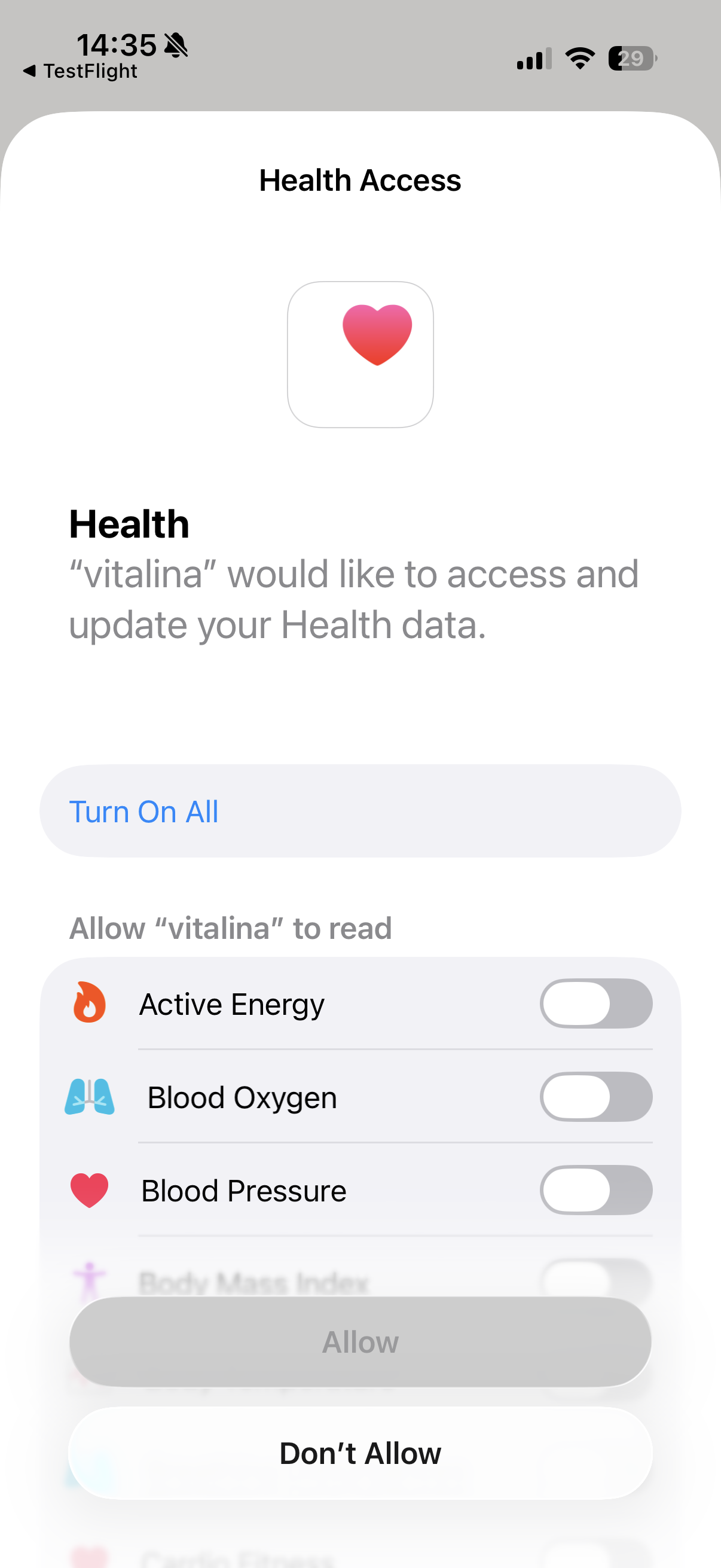
Allow access to Apple Health
When you first open vitalina, tap Allow Health Access and confirm the permissions in the Apple Health prompt. vitalina only requests read access - it cannot modify or delete your health data.
Your data never leaves your device. vitalina processes everything locally on your iPhone with no cloud uploads, no tracking, and no analytics - especially important for sensitive diabetes data.
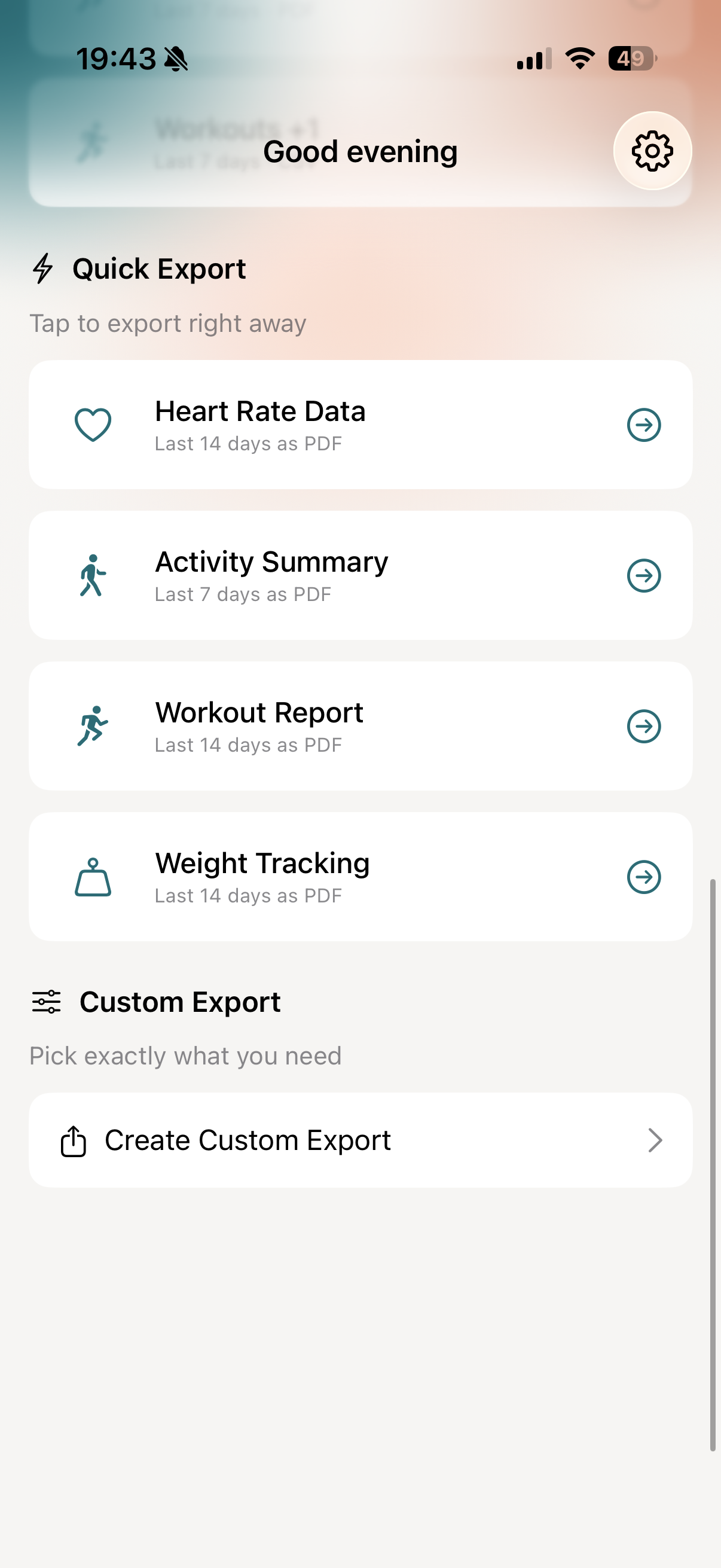
Tap Create Custom Export
On the main screen, tap Create Custom Export. There is no one-tap Quick Export template for blood glucose, so a custom export is how you pick it. The rest of this guide walks through the custom export flow.
After the first run, your glucose export stays under Recent Exports on the main screen, so next time it is one tap away. How Recent Exports work.
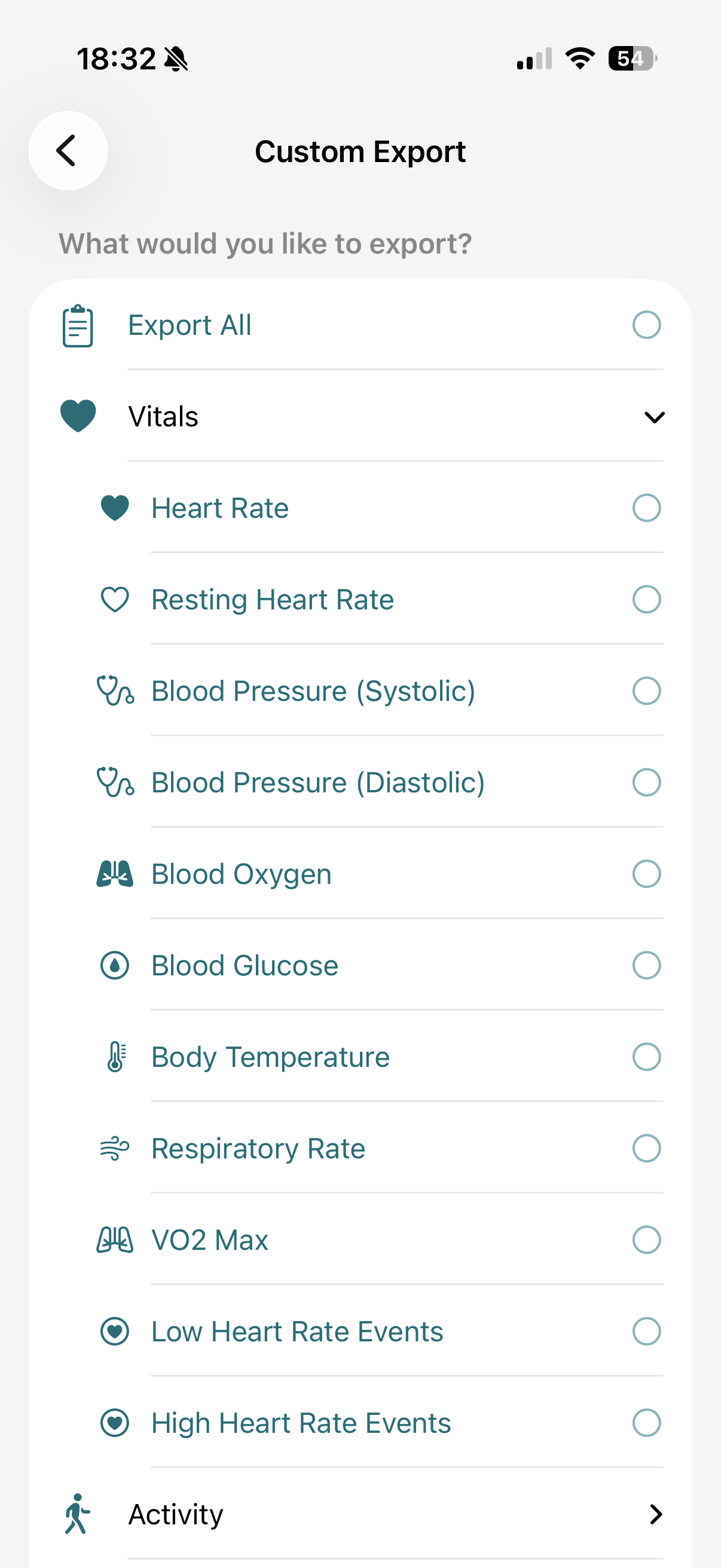
Select blood glucose
In a custom export, you'll see all available health metrics grouped by category. Under Vitals, select Blood Glucose. Values are exported in mg/dL or mmol/L based on your locale, matching how they appear in the Apple Health app.
You can also add related metrics at this step - for example Body Weight or Body Temperature - if your endocrinologist or diabetes educator wants additional context alongside your glucose readings.
Pick a date range
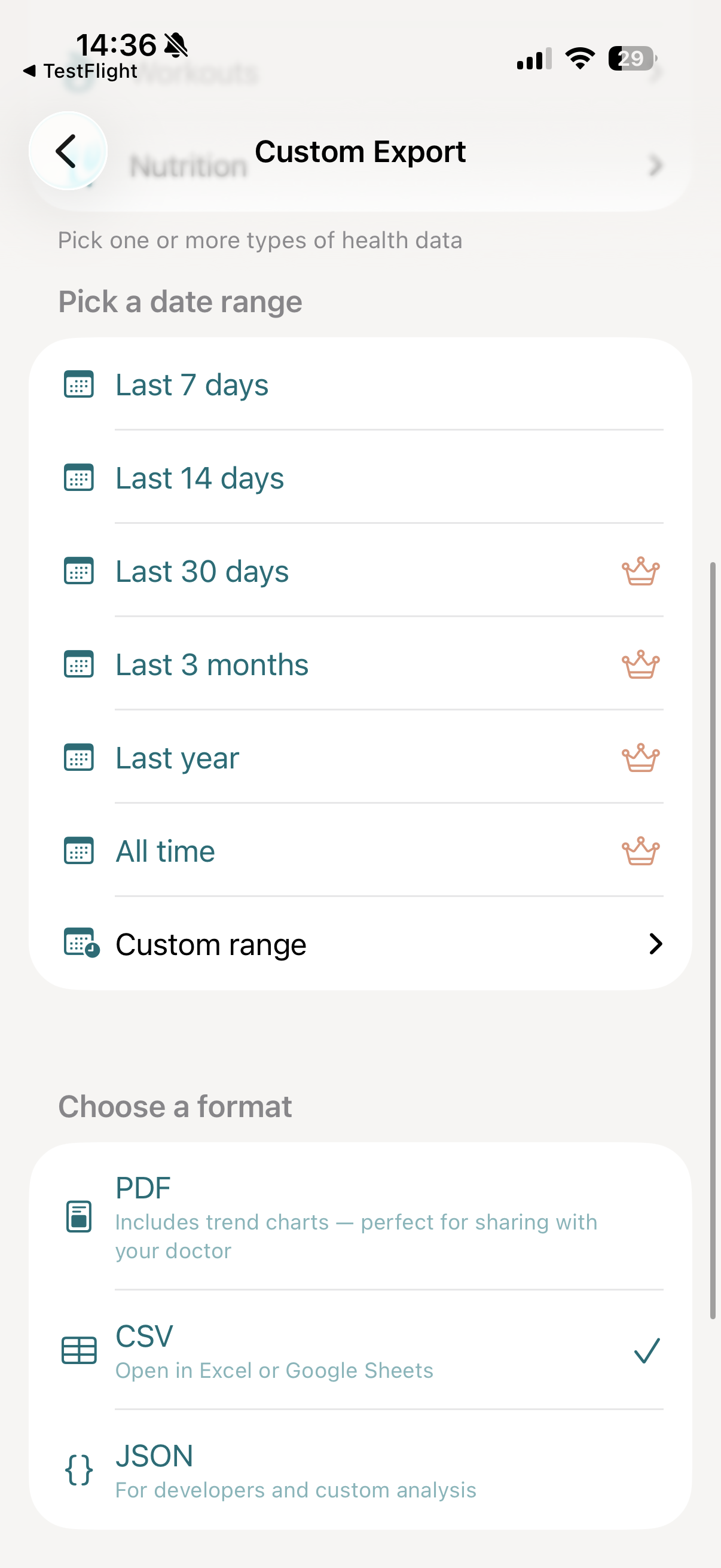
This is where vitalina makes a real difference over Apple's native export. You can choose exactly how far back to go:
- Last 7 days and Last 14 days - available for free
- Last 30 days, 3 months, 1 year, and All time - available with vitalina Pro
- Custom date range - pick any exact start and end date with Pro
For quarterly endocrinologist appointments or to supply the daily data behind an A1C lab result, the 3-month and 1-year ranges are usually what you want. The Pro upgrade is a one-time purchase that unlocks all extended date ranges.
Choose your export format
For blood glucose, two formats are most useful:
- PDF: The best format for doctor appointments. Includes a trend chart of your readings over time, a time-in-range summary, and a full table of readings with timestamps. Your endocrinologist, diabetes educator, or GP can read it without any technical knowledge. You can email it, AirDrop it, or print it before your appointment.
- CSV: Opens in Excel or Google Sheets, and imports cleanly into tools like Glooko or your own spreadsheet. Ideal if you or your care team wants to do custom analysis or combine the data with carbs, insulin, or exercise logs.
Both formats are available for free.
A readable chart, not a wall of numbers. Apple Health gives you a long table of glucose values - vitalina's PDF turns them into a trend chart with a time-in-range summary your doctor can read at a glance.
Want to build your own custom graph instead? Export to CSV and let an AI assistant chart it for you - our ChatGPT prompts guide shows exactly what to ask to turn your readings into a meaningful graph.
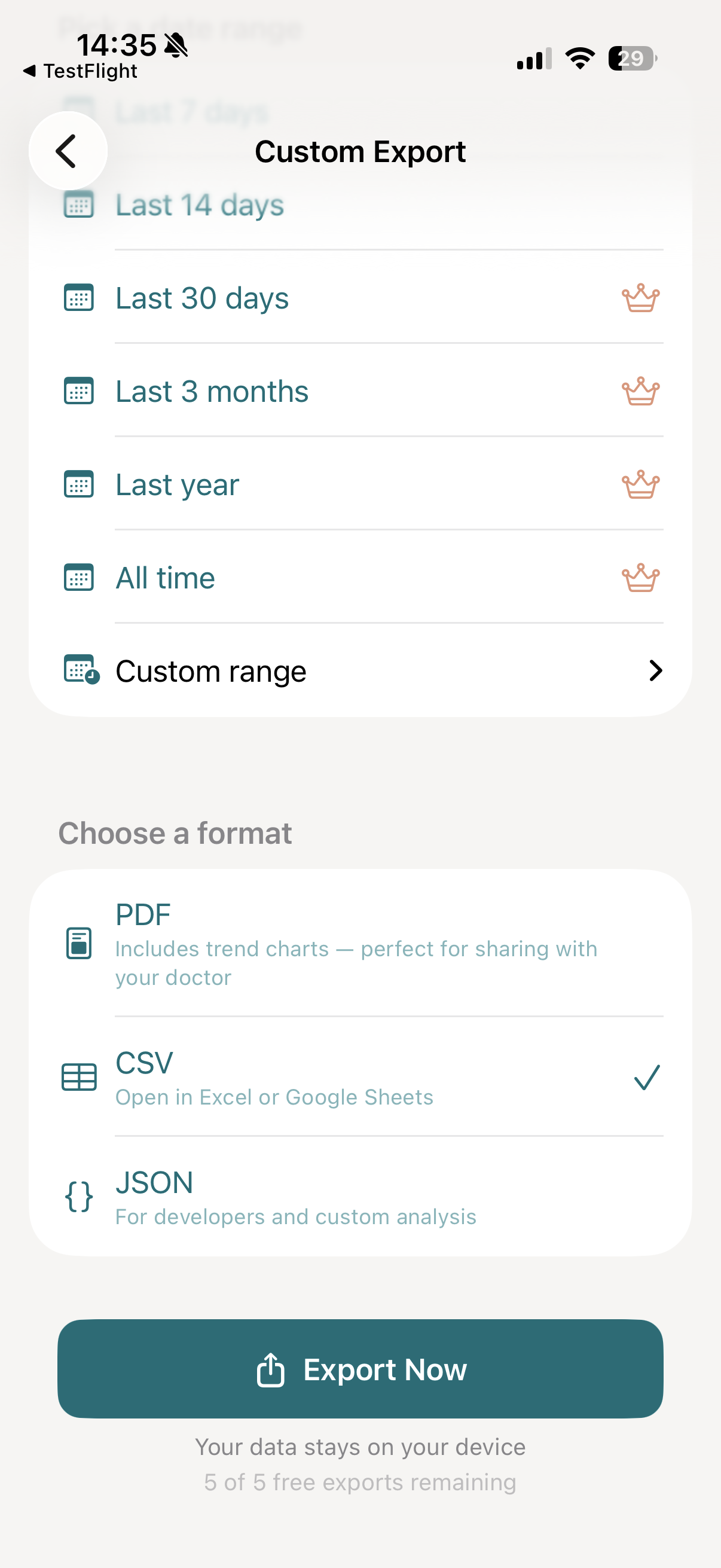
Tap "Export Now"
Tap Export Now. vitalina reads your blood glucose data from Apple Health, formats the export, and generates your file - usually within a few seconds, even for a full year of CGM readings.
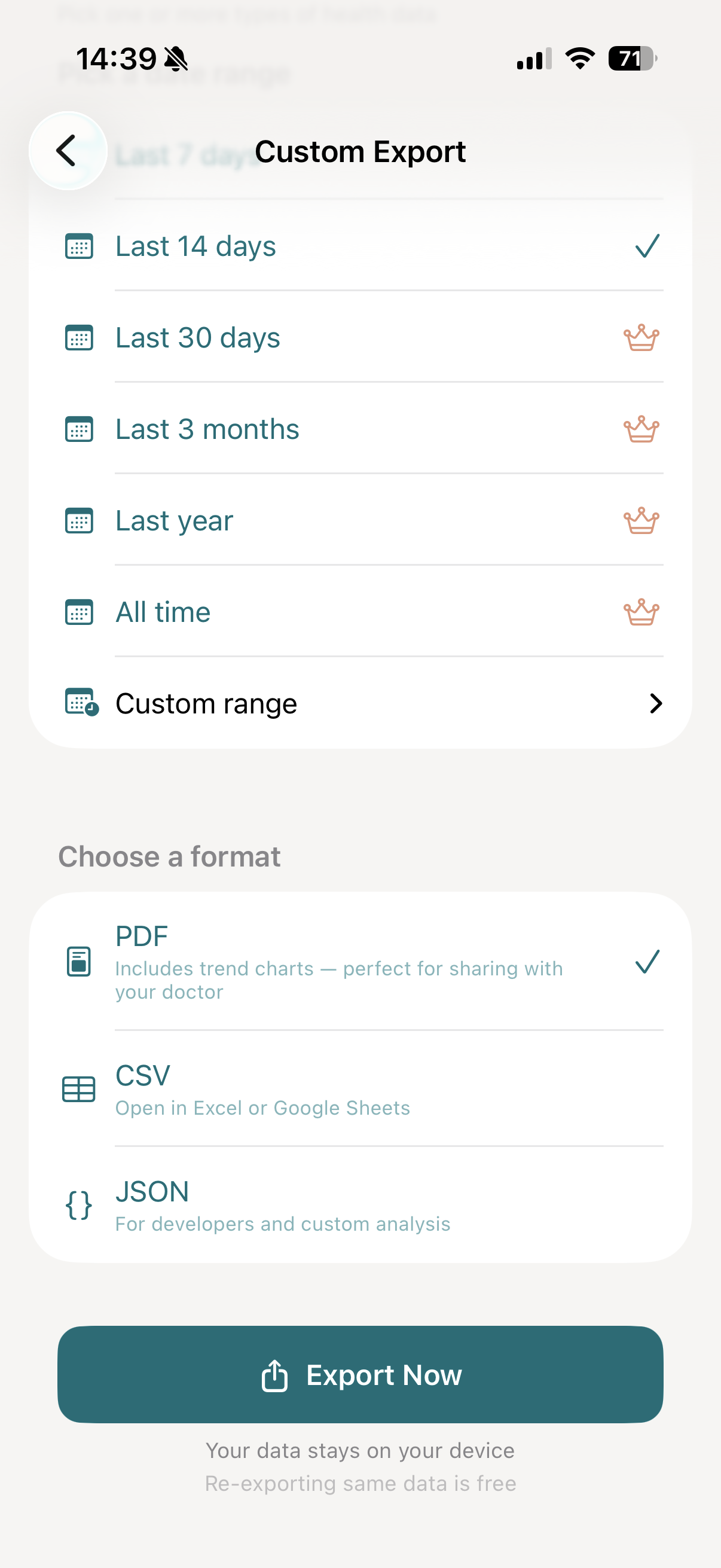
Share with your doctor
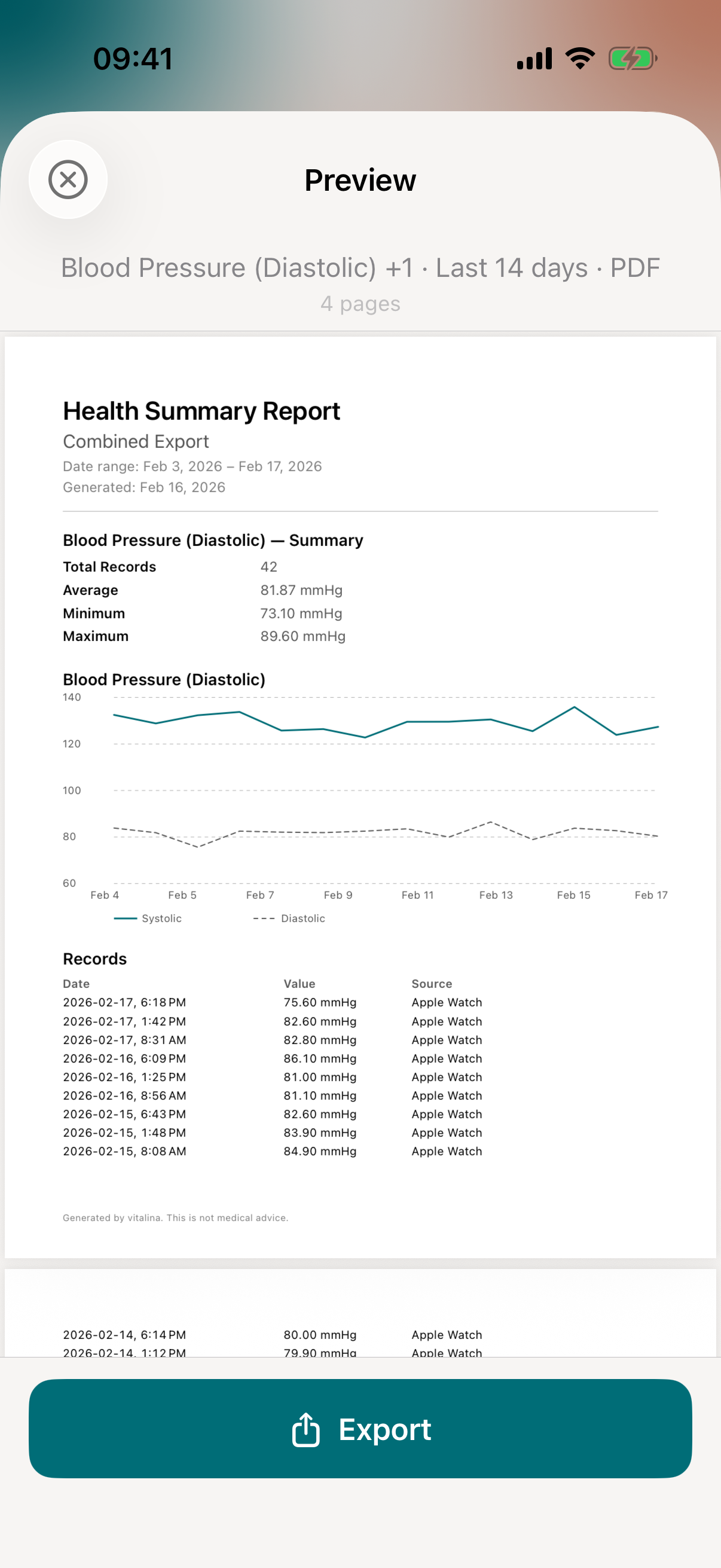
Once your export is ready, you'll see a full preview of the file. From here, tap Export to open the iOS share sheet, where you can:
- Email it to your endocrinologist, diabetes educator, or primary care physician before your appointment
- AirDrop or share via Messages to anyone nearby
- Save to Files on your iPhone or iCloud Drive
- Print a physical copy to bring to the clinic
Which devices and apps sync blood glucose to Apple Health?
vitalina exports any blood glucose readings stored in Apple Health, regardless of where they came from. This includes:
- Dexcom CGMs - G6 and G7 via the Dexcom app
- Stelo - Dexcom Stelo glucose biosensor readings via the Stelo app
- FreeStyle Libre - Libre 2 and Libre 3 via the LibreLink app
- Contour Next One - meter readings via the Contour Diabetes app
- One Drop - readings logged in the One Drop app
- Glucose Buddy - readings logged in Glucose Buddy
- mySugr - readings logged in the mySugr diabetes logbook
- Smart insulin pens - pens that log dose and meal data alongside glucose
- Manual entries - fingerstick readings entered by hand in the Health app
If the reading appears in Apple Health under Vitals → Blood Glucose, vitalina can export it - whether you're managing Type 1, Type 2, gestational, or pre-diabetes.
Using a different app or device? See how vitalina exports data from any Apple Health app.
How much does vitalina cost?
vitalina is free with 5 unique exports and date ranges up to 14 days. vitalina Pro is a one-time purchase from €3.99 (max €4.99 by region, no subscription) that unlocks unlimited exports, extended date ranges up to all time, and Shortcuts automation. Re-exporting the same configuration is always free.
Frequently asked questions
Can you export blood glucose data from Apple Health?
Yes. Apple Health stores every glucose reading from your CGM, meter, or manual fingerstick, but the native export bundles everything into one unreadable XML file. vitalina lets you export just your blood glucose data - as a clean PDF or CSV - for any date range you choose.
Can I export more than two weeks of glucose history?
Yes, with vitalina Pro. Apple's native export has no date filter at all. vitalina's free tier covers up to 14 days, and Pro (a one-time purchase) unlocks 30 days, 3 months, 1 year, and all-time history - essential for quarterly endocrinologist visits that cover months of readings, or for supporting an A1C lab with the daily context behind the average.
What format is best for sharing glucose data with my doctor?
PDF is best for clinical appointments - it includes a trend chart and a time-in-range summary your endocrinologist or diabetes educator can read immediately. CSV is better for importing into tools like Glooko or running your own analysis in a spreadsheet.
Is my glucose data safe when I export it?
Yes. vitalina processes everything locally on your iPhone. Nothing is uploaded to any server. There is no account, no cloud storage, and no analytics on your health data - which matters especially for sensitive diabetes information. The file stays on your device until you share it.
Does vitalina work with data from my CGM?
Yes. vitalina exports any glucose reading stored in Apple Health - from Dexcom (G6, G7), FreeStyle Libre (Libre 2, Libre 3), Contour, One Drop, mySugr, Glucose Buddy, or manual fingerstick entries.
What languages does vitalina support?#
vitalina is fully localized in 7 languages - English, German, Spanish, French, Portuguese (Brazil), Japanese, Russian. The app interface and every Apple Health metric name are translated, so your exports come out in your language. This page is in English, but the app follows your device language with no setup required. For example, Blood Glucose appears as:
| Language | Blood Glucose |
|---|---|
| EnglishEnglish | Blood Glucose |
| GermanDeutsch | Blutzucker |
| SpanishEspañol | Glucosa en sangre |
| FrenchFrançais | Glycémie |
| Portuguese (Brazil)Português (Brasil) | Glicemia |
| Japanese日本語 | 血糖値 |
| RussianРусский | Уровень глюкозы в крови |
Keep reading
Other Apple Health export guides
Step-by-step tutorials for every metric vitalina can export.
- Export Blood PressureSystolic and diastolic readings for your cardiologist.
- Export Heart RateResting, active, and HRV for your cardiologist or sports medicine doctor.
- Export Sleep DataSleep stages and duration for sleep specialists.
- Export WeightWeight, BMI, and body fat trends for your dietician or GP.
- Export ActivitySteps, distance, and active energy for physical therapy or rehab.
- Export WorkoutsWorkout sessions with duration, calories, and heart rate.
- Export Cycle TrackingPeriod flow, spotting, cramps, and basal body temperature for your OB-GYN.
- Export Calories & NutritionDaily calories, macros, vitamins, and minerals for your dietician or nutritionist.
- Export ECGApple Watch ECG strips with waveform, classification, and average heart rate for your cardiologist.
- Export Mental Health (State of Mind)Apple Health mental health logs with valence, emotion labels, and life-context associations for your therapist or psychiatrist.
- Export SymptomsGeneral Symptoms like fever, cough, and dizziness with their severity for your doctor.
- Export MedicationsYour Apple Health medication list and full dose log for your doctor - iOS 26 and later.
- Export Format ReferenceExact CSV columns and JSON schemas, plus a searchable dictionary of every exportable Apple Health metric.
- Export Apps & DevicesRenpho, Omron, Eight Sleep, Stelo, Flo and more - export data from any app that syncs to Apple Health.
- Export ExcelOpen your Apple Health CSV in Excel and build charts or PivotTables - works on Windows, Mac, and iPad.