
How to Export Calories & Nutrition Data from Apple Health
Last updated: April 28th, 2026

By Marina
Co-founder, vitalina

If you log meals in Yazio, MyFitnessPal, Cronometer, Lose It!, Lifesum, or any other food tracker on your iPhone, every calorie and nutrient you eat is quietly piling up inside Apple Health - daily calories consumed, protein, carbs, fiber, sugar, all four fat types, cholesterol, sodium, caffeine, plus the full list of vitamins and minerals.
When your dietician, nutritionist, GP, gastroenterologist, or sports medicine doctor asks for "a few weeks of calorie and food logs," getting that data out of Apple Health in a readable format is not straightforward.
This guide shows you how to export your calories and full nutrition data as a clean PDF or CSV file using vitalina, a free iPhone app that reads your Apple Health data and generates a clinician-ready report in under two minutes.
Why Apple Health's built-in export does not work for calories or nutrition
Apple Health does let you export your data as XML, but the result is a single file containing every health data point your iPhone has ever recorded. There is no way to filter by metric, so your calorie intake, protein, and vitamin totals are buried alongside steps, sleep, heart rate, and everything else. There is also no date range control - you cannot ask for just the last three weeks of food logs. The file is not readable by a human, and there are no daily calorie totals or summaries.
Apple does not even hand you the XML directly. You get an Export.zip archive that has to be unzipped on a computer, and the full Export.xml inside can easily reach several gigabytes for long-time Apple Watch users.
vitalina solves this by reading your Apple Health data locally on your iPhone and letting you export just your calorie and nutrition data - for any date range you choose - as a PDF or CSV.
What you'll need
- An iPhone running iOS 18 or later
- Calorie and nutrition data logged in Apple Health - typically via Yazio, MyFitnessPal, Lose It!, Cronometer, Lifesum, MacroFactor, Carb Manager, FoodNoms, or manual entries in the Health app
The walkthrough · 8 steps · ~2 min
How to export nutrition data, step by step
Download vitalina
Download vitalina from the App Store. It's free to use with no account or sign-up required.
Allow access to Apple Health
When you first open vitalina, tap Allow Health Access and confirm the permissions in the Apple Health prompt. vitalina only requests read access - it cannot modify or delete your health data.
Your data never leaves your device. vitalina processes everything locally on your iPhone with no cloud uploads, no tracking, and no analytics.
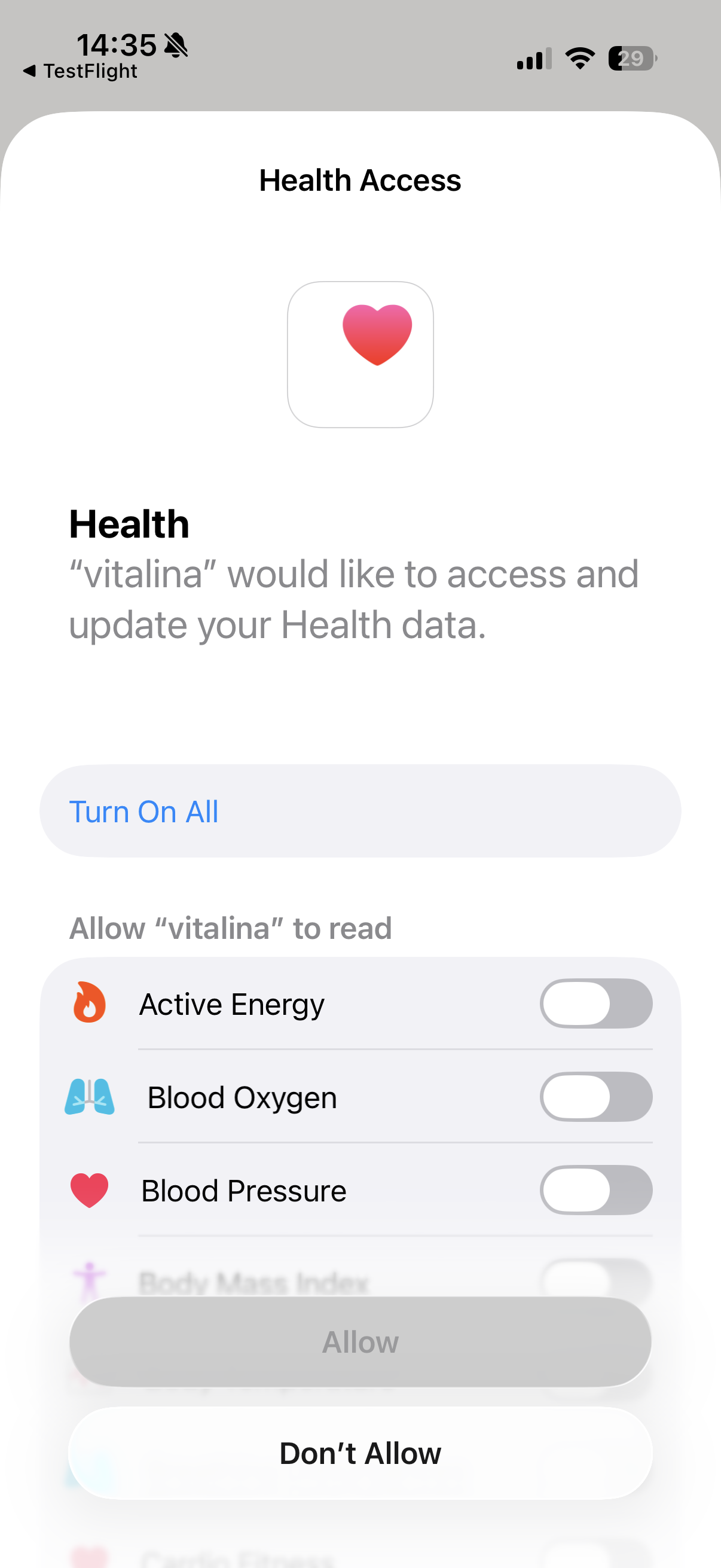
Pick a Quick Export template or create a custom export
On the main screen, you'll see a set of one-tap Quick Export templates. If you prefer full control over which nutrients are included and the date range, tap Create Custom Export instead. The rest of this guide walks through the custom export flow.
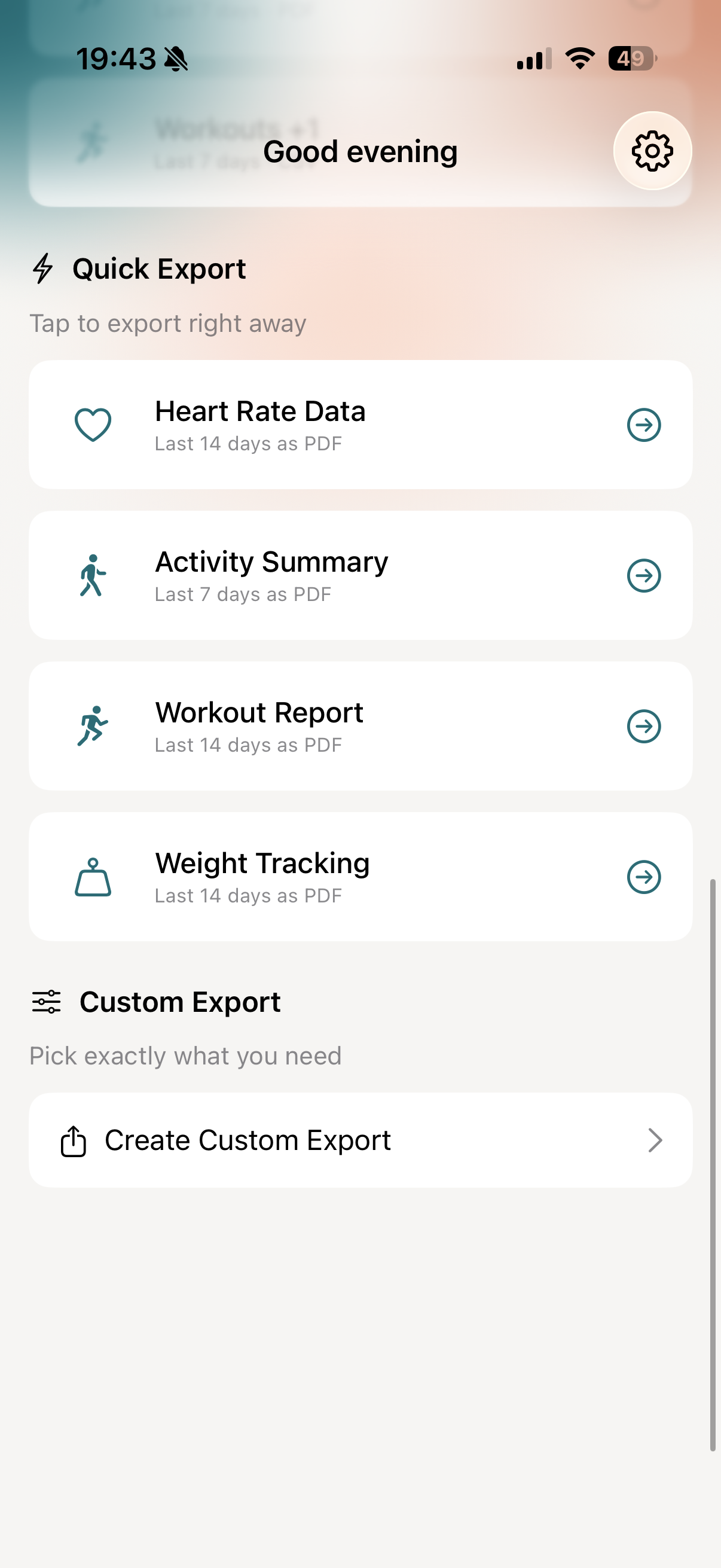
Select calories and nutrition metrics
In a custom export, you'll see all available health metrics grouped by category. Open the Nutrition section and pick what you need. vitalina supports every nutrition type Apple Health stores:
- Calories (called Dietary Energy in Apple Health) - your daily total calorie intake from every meal logged
- Water - hydration entries logged manually or by your food tracker
- Macros (individually selectable): protein, carbohydrates, fiber, sugar, total fat, saturated fat, monounsaturated fat, polyunsaturated fat, cholesterol, sodium, and caffeine
- Vitamins (bundled toggle at the bottom of the list - one tap selects all 13): A, B1 (thiamin), B2 (riboflavin), B3 (niacin), B5 (pantothenic acid), B6, B7 (biotin), B9 (folate), B12, C, D, E, and K
- Minerals (bundled toggle at the bottom of the list - one tap selects all 13): calcium, chloride, chromium, copper, iodine, iron, magnesium, manganese, molybdenum, phosphorus, potassium, selenium, and zinc
The vitamins and minerals bundles each show a none/partial/all checkmark state, so you can also drill in and pick individual nutrients - useful if you only need to show, say, iron and B12 to your hematologist.
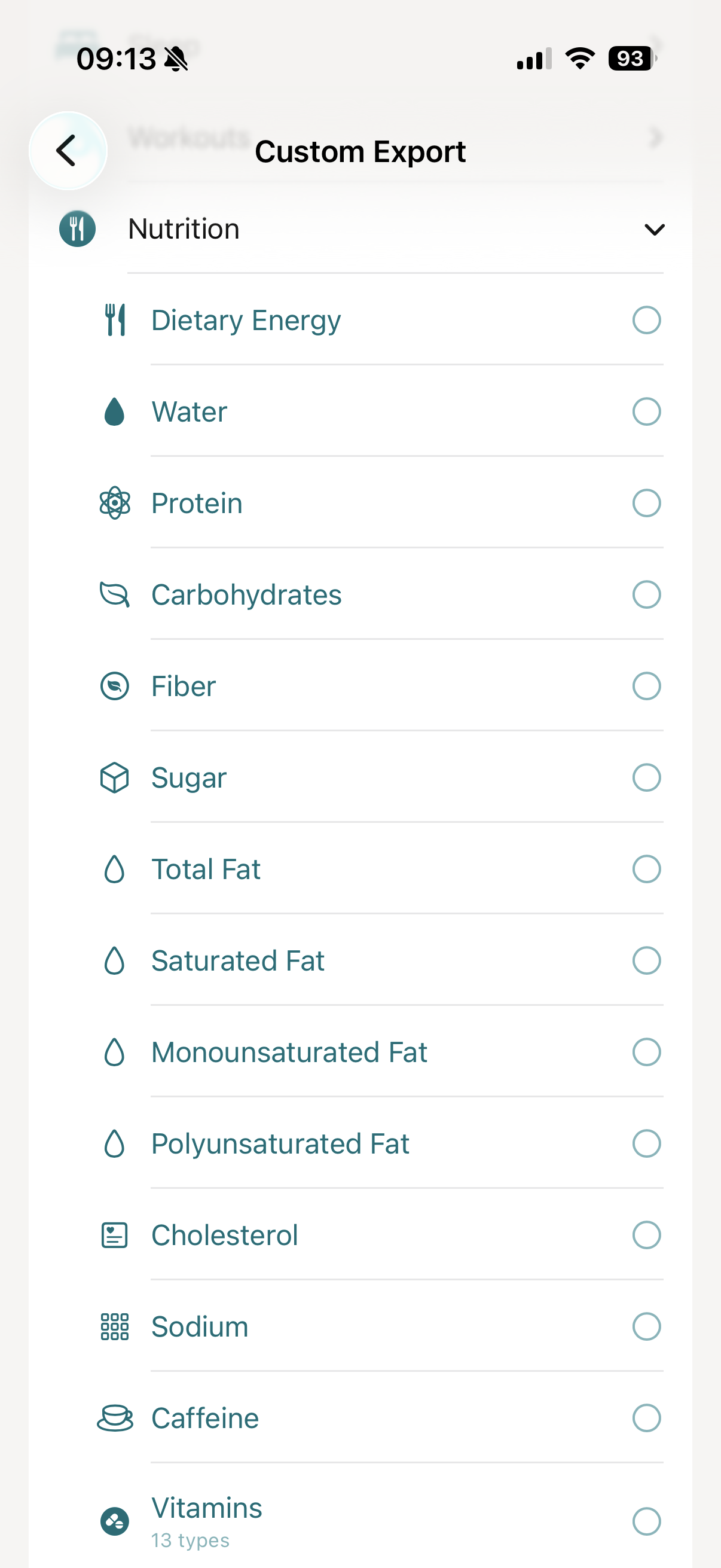
Pick a date range
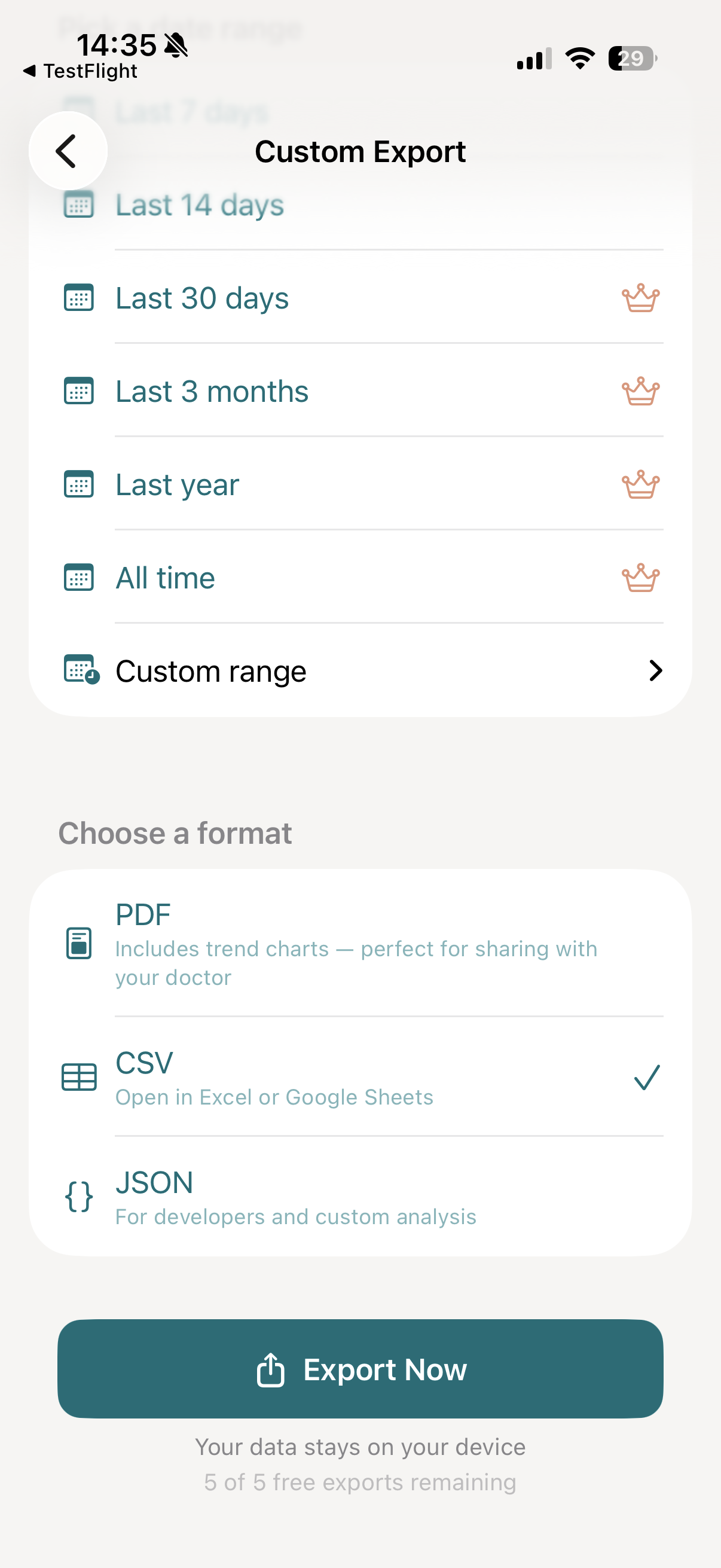
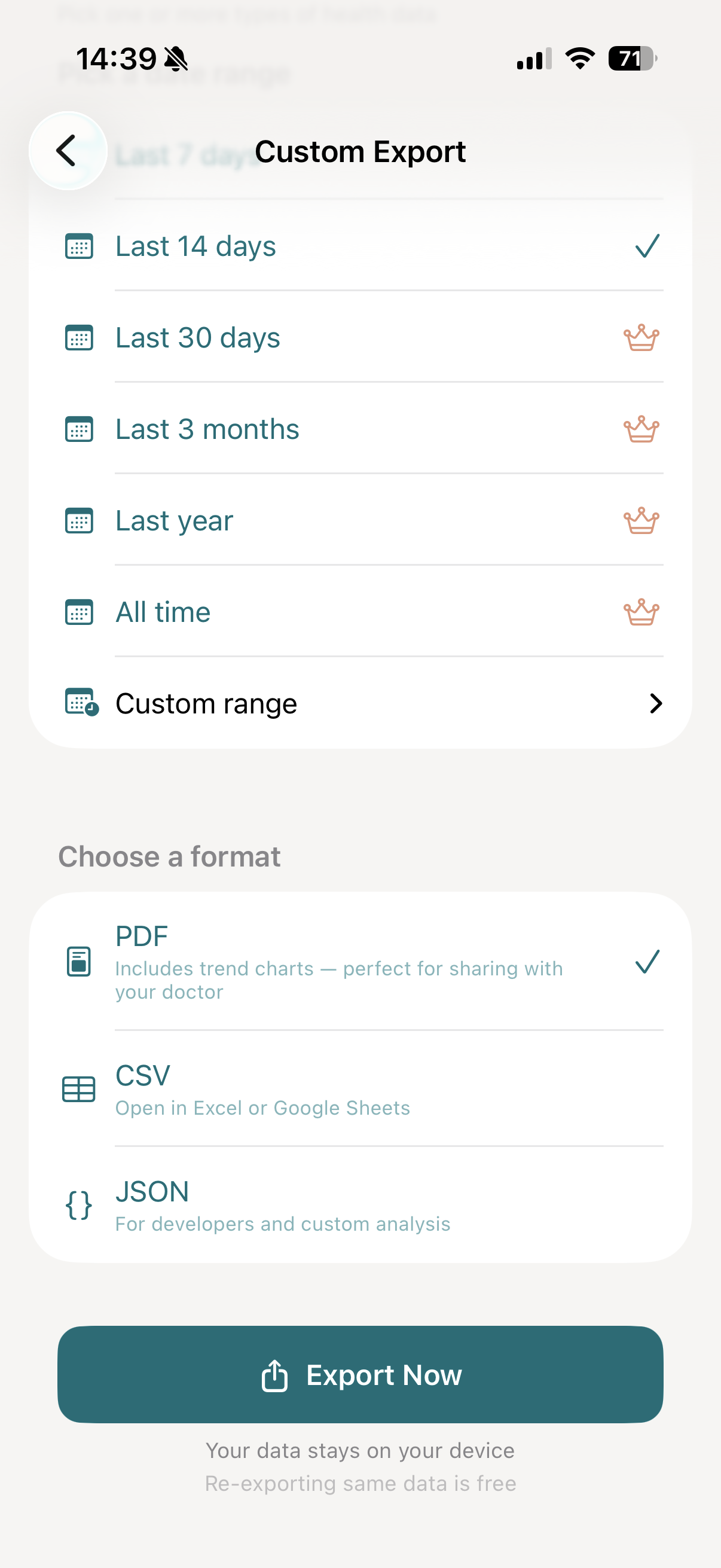
Nutrition reviews usually span a few weeks - long enough to see real patterns, short enough to remember what you ate. vitalina lets you choose exactly how far back to go:
- Last 7 days and Last 14 days - available for free
- Last 30 days, 3 months, 1 year, and All time - available with vitalina Pro
- Custom date range - pick any exact start and end date with Pro
If your dietician or gastroenterologist asks for several months of food logs - for an elimination diet review, IBS or SIBO workup, eating disorder recovery, or tracking a structured cut/bulk cycle - the Pro upgrade is a one-time purchase that unlocks all extended date ranges.
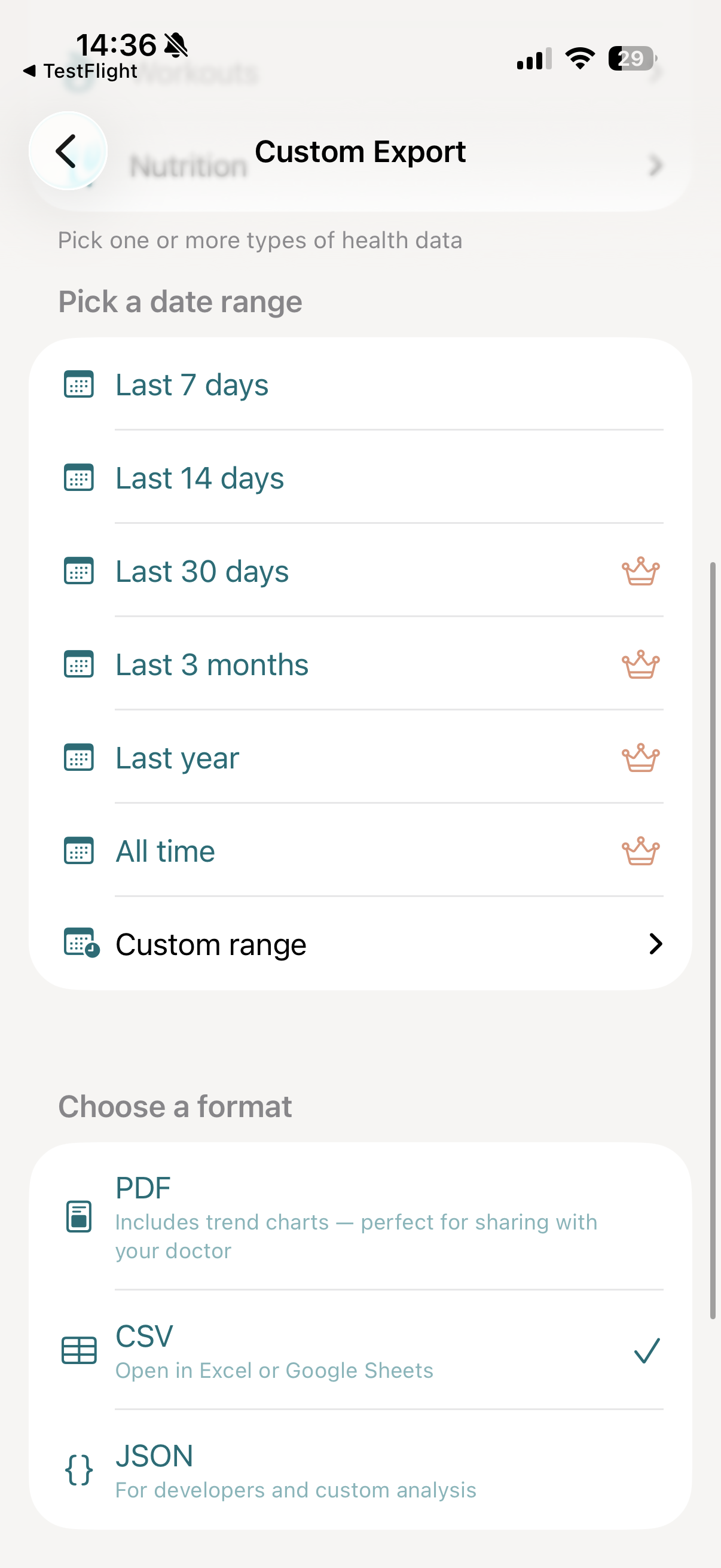
Choose your export format
For calorie and nutrition data, two formats cover most needs:
- PDF: The best format for clinician appointments. Includes daily calorie totals, a clean per-nutrient table, and formatting your dietician can read at a glance. You can email it, AirDrop it, or print it before your appointment.
- CSV: Opens in Excel or Google Sheets. Ideal if you or your dietician wants to compare daily calories against your target, build custom charts, or pull the data into another tool.
- JSON: Useful for piping calorie and nutrition data into ChatGPT for analysis or another health app.
All three formats are available for free.
Tap "Export Now"
Tap Export Now. vitalina reads your calorie and nutrition data from Apple Health, formats the export, and generates your file - usually within a few seconds.
Share with your dietician
Once your export is ready, you'll see a full preview of the file. From here, tap Export to open the iOS share sheet, where you can:
- Email it to your dietician or care team before your appointment
- AirDrop or share via Messages to anyone nearby
- Save to Files on your iPhone or iCloud Drive
- Print a physical copy to bring to the clinic
Which calorie and food trackers sync to Apple Health?
vitalina exports any calorie or nutrition data stored in Apple Health, regardless of where it came from. This includes:
- Yazio - daily calories, macros, and water; popular calorie counter across Europe
- MyFitnessPal - calories, macros, and the full vitamin/mineral list (Premium plans write more nutrients)
- Cronometer - one of the most thorough syncers, with calories plus all macros, vitamins, and minerals
- Lose It! - calories, macros, and key micronutrients
- Lifesum - calories, macros, and selected micronutrients
- MacroFactor - calories, macros, and fiber
- Carb Manager - calories and macros, useful for keto and low-carb tracking
- FoodNoms - native iOS food tracker with full Apple Health sync
- Manual entries - calories and nutrients entered by hand in the Health app
If a calorie reading or nutrient appears in Apple Health under Nutrition, vitalina can export it.
Using a different app or device? See how vitalina exports data from any Apple Health app.
Automate weekly nutrition exports with Shortcuts
If you want to send your dietician a fresh PDF every week, you can pair vitalina with Siri Shortcuts to run the same export on a schedule - no need to set it up by hand each time.
See the Shortcuts automation guide for a step-by-step walkthrough.
How much does vitalina cost?
vitalina is free with 5 unique exports and date ranges up to 14 days. vitalina Pro is a one-time purchase from €3.99 (max €4.99 by region, no subscription) that unlocks unlimited exports, extended date ranges up to all time, and Shortcuts automation. Re-exporting the same configuration is always free.
Frequently asked questions
Can you export calories from Apple Health?
Yes. Apple Health stores every calorie and nutrient logged by food-tracking apps like Yazio, MyFitnessPal, Lose It!, Cronometer, and Lifesum (under Dietary Energy), but only lets you export everything as an unfiltered XML file. vitalina lets you export just your calorie and nutrition data - as a clean PDF or CSV - for any date range you choose.
Which nutrition metrics can I export?
vitalina supports the full Apple Health nutrition catalog: calories (Dietary Energy), macros (protein, carbs, fiber, sugar, total/saturated/monounsaturated/polyunsaturated fat, cholesterol, sodium, caffeine), all 13 vitamins (A, B1 through B12, C, D, E, K), and all 13 minerals (calcium, chloride, chromium, copper, iodine, iron, magnesium, manganese, molybdenum, phosphorus, potassium, selenium, zinc).
Can I export more than one month of calorie and nutrition history?
Yes, with vitalina Pro. The free tier covers up to 14 days. Pro (a one-time purchase) unlocks 30 days, 3 months, 1 year, and all-time history. You can also set a custom start and end date - useful for an elimination diet trial or a specific cut/bulk cycle.
Does vitalina work with Yazio, MyFitnessPal, Cronometer, and other food trackers?
vitalina exports any calorie and nutrition data stored in Apple Health, so it works with Yazio, MyFitnessPal, Lose It!, Cronometer, Lifesum, MacroFactor, Carb Manager, FoodNoms, and any other tracker that syncs to Apple Health.
Is my calorie and nutrition data safe when I export it?
Yes. vitalina processes everything locally on your iPhone. Nothing is uploaded to any server. There is no account, no cloud storage, and no analytics on your health data. The file stays on your device until you share it.
What languages does vitalina support?#
vitalina is fully localized in 7 languages - English, German, Spanish, French, Portuguese (Brazil), Japanese, Russian. The app interface and every Apple Health metric name are translated, so your exports come out in your language. This page is in English, but the app follows your device language with no setup required. For example, Dietary Energy appears as:
| Language | Dietary Energy |
|---|---|
| EnglishEnglish | Dietary Energy |
| GermanDeutsch | Nahrungsenergie |
| SpanishEspañol | Energía dietética |
| FrenchFrançais | Énergie alimentaire |
| Portuguese (Brazil)Português (Brasil) | Energia alimentar |
| Japanese日本語 | 食事エネルギー |
| RussianРусский | Энергия из питания |
Keep reading
Other Apple Health export guides
Step-by-step tutorials for every metric vitalina can export.
- Export Blood PressureSystolic and diastolic readings for your cardiologist.
- Export Heart RateResting, active, and HRV for your cardiologist or sports medicine doctor.
- Export Blood GlucoseCGM and fingerstick readings for your endocrinologist.
- Export Sleep DataSleep stages and duration for sleep specialists.
- Export WeightWeight, BMI, and body fat trends for your dietician or GP.
- Export ActivitySteps, distance, and active energy for physical therapy or rehab.
- Export WorkoutsWorkout sessions with duration, calories, and heart rate.
- Export Cycle TrackingPeriod flow, spotting, cramps, and basal body temperature for your OB-GYN.
- Export ECGApple Watch ECG strips with waveform, classification, and average heart rate for your cardiologist.
- Export Mental Health (State of Mind)Apple Health mental health logs with valence, emotion labels, and life-context associations for your therapist or psychiatrist.
- Export SymptomsGeneral Symptoms like fever, cough, and dizziness with their severity for your doctor.
- Export MedicationsYour Apple Health medication list and full dose log for your doctor - iOS 26 and later.
- Export Format ReferenceExact CSV columns and JSON schemas, plus a searchable dictionary of every exportable Apple Health metric.
- Export Apps & DevicesRenpho, Omron, Eight Sleep, Stelo, Flo and more - export data from any app that syncs to Apple Health.
- Export ExcelOpen your Apple Health CSV in Excel and build charts or PivotTables - works on Windows, Mac, and iPad.